Thursday, September 30, 2021

A Perfect Day

 My wife Julie chose the title for this post which sums up beautiful weather, good friends and delightful surroundings.  I think this title takes on deeper meaning in the midst of the Covid pandemic that we are all struggling through. For Julie and I our gathering was a date long anticipated as we have been staying close to home and being very cautious about crowds, masks, vaccines and venues. I don't think our human species was meant to spin cocoons and wait out a transformation.

Our friends Bob and Sandy have been so generous in sharing their "time share" at North Myrtle Beach South Carolina each year. Their generosity also includes sharing their friends Mike and Kathleen who we have come to look forward to seeing. Julie enjoyed her walks through the neighberhoods to keep up her fitness routine.  As I've gotten older, walking the beach has had less appeal but discovering the little marshlands scattered around has meant great bird photography.


Brookgreen gardens is a must visit site. Listed as one of the finest gardens in the USA it highlights Carolina rice culture as well as the owners love of sculpture and local flora.


After taking in the sculpture gardens we decided to take the boat tour through the rice fields. Our guide told us of the various families that owned the plantation and the many enslaved people who worked the fields. Though slave life everywhere had to be horrendous a slave's life on the rice plantations was particularly hard.  Rice cultivation led to very short lifespans; hard labor in hot humid surroundings and in areas filled with poisonous snakes and alligators.


Belted King Fisher


While touring the rice fields with their many rivers and canals we learned of the people who live today on some of the islands in the area. South Carolina provides School Boat service that shuttles the children who live on the islands to the area school.


Another perfect day was offered up at the Russell Burgess Wildlife area.  Coordinating my visits with "Low Tide" provided an abundance of wading shore birds and opportunities to perfect my birds-in-flight skills.


Capturing images of birds in flight requires a coming together of many factors. Good light, precise camera settings, good equipment and good-luck. As I've gotten older it has become more difficult to manage the heavy glass required for these shots. Hats off to Nikon for their new line of fresnel lenses which reduce the weight of the lens by about 5 lbs. 


This year I was able to observe a special treat.  Roseate Spoonbills, a southern bird, have been moving north and can now be regularly seen along the coastal shores of South & North Carolina. As climate changes so do the birds habitats.


A Juvenile Black Crowned Night Heron with what looks like a baby green sea turtle 


Egrets were plentiful on this perfect day. Following is a collection of my favorites.


                                                                        Snowy Egret


                                                                      White Ibis flock in flight


                     White Egret creating a shade canopy with its wings to better to see fish in the water


                                                     Tri-colored Heron with a nice fish


Little Green Heron with a sea worm


                                                                        Hello Matey


Yellow Rumped Warbler


                                                        Harrier Hawk scanning the Marsh


                                                             A Common Cormerant


                                                                             Osprey


                                                                      Snowy Egret 


Thanks for visiting! Wishing you a Perfect Day


Saturday, June 5, 2021

Following the Red Shouldered Hawks of Lake Monticello


For the past two years I have had the pleasure of following the nesting lives of two red-shouldered hawk families here at Lake Monticello, Virginia.  Red shouldered hawks are common in our area due to the abundance of mature forest which is their preferred habitat. They are part of the Buteo category of raptors which are comprised of larger soaring hawks with broad wingspans. Red Shouldered hawks can be identified by having a white line of stripes on their wing and tail and a touch of red on their shoulders. They are a medium-sized Buteo with a wingspan of around 3 feet. The female and male look alike with the female being slightly larger in build. They are a territorial species with pairs often chasing out rivals from their domain.


Our story begins when I managed to catch a photo of a male and female Red-Shouldered hawk together at the beginning of this season. Our hawks will stay together for the season, mating, nest building, and raising their young. Nests are often used year after year. Mating occurs in late February early March. After mating, a period of 4-6 weeks of nest building begins.


Red Shouldered hawks build their nests in the fork of a strong tree in wooded lots sometime close to houses. Our nest this year, on a neighbors lot, was within view of my telephoto lens making it an ideal location to follow the family’s progress. I managed to find a perfect location on the driveway enabling me to stay far away in my car, so as not to disturb them. As they build their nests Red Shouldered hawks will add greenery possibly to tell other species that this nest is occupied. As testimony to the strength of this nest we experienced a quick passing storm with 90 mph winds, shaking and toppling trees. Our hawks’ structure survived the storm, due to their superior engineering skills. 


Hawks of this species usually raise two to four eggs which the female lays in late march. She will leave the nest for short periods to gather sticks to fortify the nest. The male will bring food to the female and share in guarding the nest while she is away. Building a nest close to housing brings with it problems for these territorial birds. Doing yard work our neighbors often experienced the hawks making swooping dives towards them sensing a threat.


After a period of 30 days the eggs begin to hatch. Then the real activity begins. Mom and Dad stay busy going on the search for food and shoring up the nest. This year I was fortunate to catch one of the parents hunting on my property. The hawk perched on a low branch of a tree and swooped down gliding across the forest floor looking for prey. I doesn't appear he was successful this run. 


Hunting in the forest leaf litter


Red Shouldered hawks feed on reptiles, amphibians, small birds and small mammals. The hunters will perch on a limb and drop down on prey in the leaf litter below. Red Shouldered hawks are proficient hunters of young squirrels.


Tonight a gourmet meal of frogs legs


Chicks begin as fuzzy little creatures with white down and demanding open mouths.  As they grow they will shed their down and replace it with the feathers that will enable them to fledge.


Chicks will begin to leave the nest about 35-45 days after hatching. They will stay close by as their parents teach them how to hunt for their own food. In my observations two years ago I could see the young hawks sitting in nearby branches looking upon the parents for an easy meal. When the parents sense they are ready they will stop feeding the young hawks so that they can go off and make it on their own. This picture from two years ago shows our chicks just about ready to fledge. 


I read where with some raptors, the parents will stick spike-like branches in the nest to discourage the young from returning to the nest. I tried this myself with my nesting college-age children. Effectively playing classical music all the time at home forced the graduating seniors to fledge, find employment, and not return to the nest. 


Unfortunately, not all stories have a happy ending. This year’s family in mid May abandoned the nest after the chicks disappeared one night.  I suspect that the chicks may have been taken by a predator such as a snake, a raccoon or possibly an aggressive owl. Mom and Dad seemed to begin to build another nest in an adjacent location almost immediately. The instinct to reproduce the species is strong.


Following these hawks over the past several years has been a true pleasure. A weekly observation of the nest recorded significant progress with each visit and morning sunlight provided for successful photography.


I close with a picture of our Red Shouldered family from two years ago as they posed for a family portrait.  Special thanks to my neighbor for allowing me to photograph this journey on their property.


Friday, February 12, 2021

The Irruption of 2020-2021


I don’t know about you but the word irruption doesn’t conjure up a positive image to me. As I sit here at my desk a former President is being impeached after the January 6th Capital riot, Covid is surging in my state of Virginia, Vaccine distribution is still months off, and I've been quarantined from family and friends for almost a full year. With all that has gone on in the past year an irruption would not be totally welcome. But I am talking about a different irruption - the irruption of birds. Ornithologists are referring to it as the Winter Finch Irruption of 2020-21.


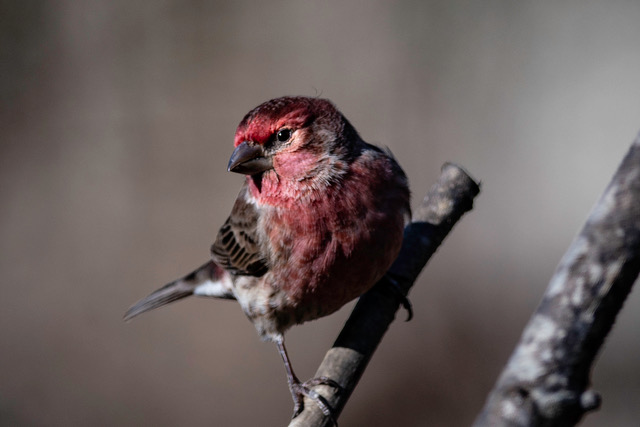
Purple Finch

Pause for a moment amidst all the stresses of the day and take a look out of your window. If you feed the birds or watch the shrubs and bushes you will notice something unusual going on that occurs in our area every 3-4 years. You will see all your familiar winter birds, like the beautiful Cardinals, the perky Carolina Wrens and the colorful Bluebirds but this year you will see masses of Finch-like birds invading your yard.  Such species as House Finches with their splash of red, Pine Siskins, Red Polls, Purple finches, Juncos,  and the beautiful Red Breasted Nuthatch. These birds are visiting us this winter in far greater numbers than seen in the last 20 years. It's being referred to as a "Super Irruption". Slightly north of us the States are experiencing an influx of the beautiful Evening Grosbeaks, also a seed eater.


Red Breasted Nuthatch

The answer for the increase lies in the cold north. Ron Pittway, a noted Canadian ornithologist from Toronto has studied finches for many years as an employee of the Algonquin Provincial Park. He started publishing his annual count in 1999. No question, these birds of the north are moving south, as far as North Carolina in what has been labeled a “Finch Irruption”.


                                                             White Breasted Nuthatch

These northern small perching birds are moving south due to a scarcity of food stuffs that are part of their routine diet in the boreal forests of Canada.   Finches and their relatives prefer pine nuts found in conifers, which are also found here in our Piedmont area. Seeds at backyard feeders are an welcome buffet.


Pine Siskin


An interesting phenomenon has been studied which identifies a cyclical relationship between trees and seed-eaters like birds and squirrels. The relationship seems almost supernatural at first glance as if the trees and squirrels are communicating with each other. Who better to know a tree than a squirrel? 


Grey Squirrels -"Sciurus Pain-in-necksis"


Here’s my condensed version of what is going on. Trees produce an abundance of seeds in a given year in order to reproduce. In response birds and squirrel populations increase with the abundance of food in that year, inhibiting the trees ability to reproduce. The trees respond in mass by not producing as many seeds in the next year. The squirrels in particular reduce the size of their litters due to the shortage of food. The following year the trees rebound producing an abundance of seeds in order to reproduce amongst the smaller squirrel population.  The seed-eating birds head south in the lean years and THAT in part is what we are experiencing here this winter. And thus, the cycle continues. This year there is a greater scarcity of seeds in the north. This cycle of "Boom-Bust" may also answer my question as to why only in certain years there are acorns on the ground everywhere causing me to “roller-skate” on my garden path.


Dark -Eyed Junco


Trees and Squirrels communicating? Sounds like the stuff of science fiction, but this year…I’ll believe anything. Search the Cornell University E-Bird site for more information. Wonder in the cycle of living systems and keep those bird feeders full. How many of these finch-like birds do you see?


House Finch


Goldfinch in Winter Plumage